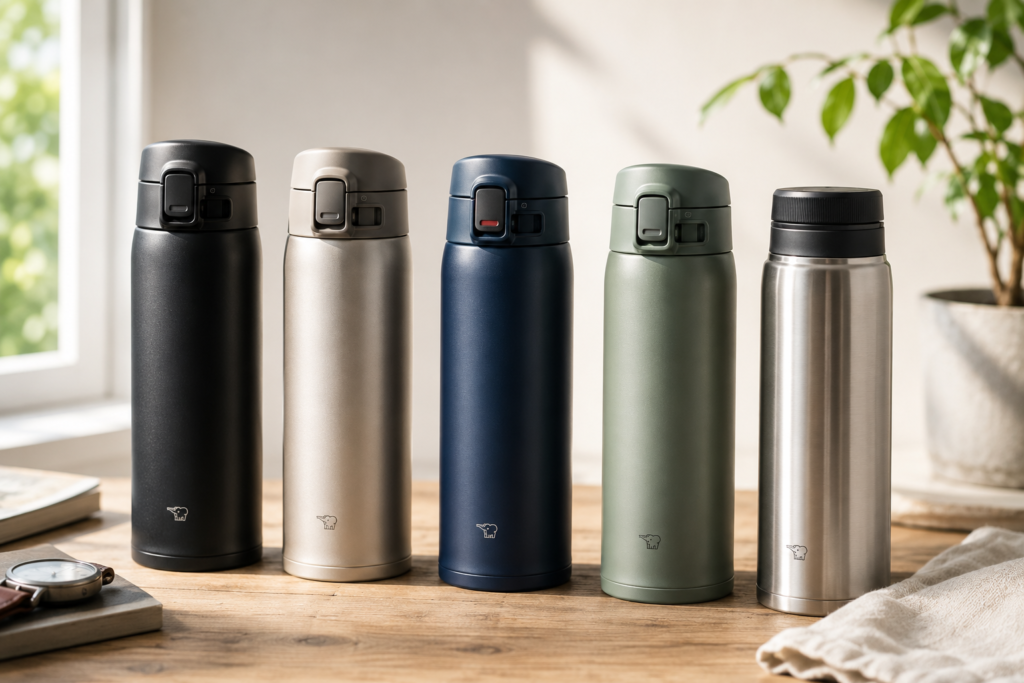
Quick Verdict
If you want the best insulated bottle money can buy, Japanese brands Zojirushi and Tiger are the gold standard. The Zojirushi SM-SA60BA is our top overall pick — backed by over 32,000 Amazon reviews and a price that won’t break the bank. For serious tea or coffee drinkers who want Made-in-Japan craftsmanship, the Tiger MJF-A048XF is worth every penny of its premium price.
Walk into any Japanese train station on a Monday morning and you’ll see something striking: almost every commuter is carrying a slim, sleek water bottle. In Japan, this is called a suitou (水筒) — a personal insulated bottle that’s as essential as a wallet or phone. Japanese schoolchildren bring them to class, office workers carry them to meetings, and hikers take them up mountains.
This culture of daily hydration has pushed Japanese manufacturers to engineer vacuum insulated bottles to a level that most Western brands simply haven’t matched. Zojirushi and Tiger — both founded in Osaka over 100 years ago — have spent decades perfecting the science of temperature retention. The result? Bottles that keep coffee scalding hot for six-plus hours and cold drinks ice-cold all day, with lids engineered to survive years of daily use without leaking.
In this guide, we’ve picked the best Zojirushi and Tiger bottles available on Amazon.com right now, with honest takes on who each one is best for.
🔬 Why Japanese Insulated Bottles Are in a Class of Their Own
Not all double-wall vacuum bottles are created equal. Here’s what separates Zojirushi and Tiger from the competition:
- Copper sheet interlayer: Tiger’s premium MJF series adds a copper sheet between the vacuum walls to reflect radiated heat — not just block conduction. This is the same physics principle used in spacecraft insulation, and it delivers measurably better temperature retention.
- 18/8 food-grade stainless steel (SUS304): Both brands use this alloy, which offers superior corrosion resistance and leaves absolutely no metallic taste, even with acidic drinks like lemonade or cold brew coffee.
- Proprietary interior finishes: Zojirushi’s nonstick-coated interior and Tiger’s Super Clean Plus finish resist tea tannins and coffee stains. After months of daily use, the interior stays odor-free and easy to rinse clean.
- Monozukuri engineering precision: Japan’s manufacturing culture of meticulous craftsmanship means gaskets, hinges, and lid mechanisms are built to extremely tight tolerances. The lids don’t rattle, the seals don’t fail, and the hinges don’t crack after a year.
- Published temperature specs: Unlike many brands that make vague claims, Zojirushi and Tiger publish exact test results — for example, the Zojirushi SM-SA60BA keeps liquid at 163°F (73°C) after 6 hours starting from 203°F (95°C). You know exactly what you’re getting.
- BPA-free across the lineup: Every recommended bottle in this guide is fully BPA-free.
Founded in 1918 and 1923 respectively, both companies have a century of manufacturing knowledge baked into every product. They weren’t chasing trends — they were perfecting a core technology.
🎯 How to Choose the Right Japanese Insulated Bottle
Before diving into specific picks, here are the key factors to consider:
Capacity: For a standard commute or desk use, 16–20 fl oz (480–600ml) is the sweet spot — enough for two cups of coffee but compact enough to fit in a bag pocket. If you want all-day hydration without refilling, look at 32 fl oz (950ml) options. Most Japanese bottles run slightly smaller than American hydration brands like Stanley or Hydro Flask, which is actually a feature: they’re lighter and more portable.
Lid type:
- Flip-open / one-touch: Best for commuters and anyone drinking one-handed. Zojirushi’s flip lids open and close with a satisfying click and lock securely to prevent accidental opening in a bag.
- Screw cap: Maximally leak-proof and often slightly better for heat retention. Ideal for outdoor activities or packing in a backpack. Tiger’s MJF-A048XF uses a screw cap with a wide mouth (1.9 inches / ~48mm) that fits standard ice cubes.
Interior finish: If you drink coffee or tea daily, prioritize models with a nonstick or Super Clean Plus interior. Plain stainless interiors are durable but can absorb staining over time without proper cleaning.
Weight: Japanese bottles are remarkably light. The Tiger MMJ-A048 (16.9 fl oz) weighs just 0.5 lbs (about 225g) — far lighter than comparable American brands at the same capacity.
Dishwasher safety: Most Japanese vacuum bottles are hand-wash only (the lids especially). If dishwasher compatibility is a must, check the specific model specs before buying.
💡 Tip: To get the best performance out of any vacuum bottle, “pre-condition” it before filling. Rinse it with hot water for hot drinks (or ice water for cold) and let it sit for 30 seconds, then dump it out before adding your drink. Pre-warming or pre-chilling the steel reduces the initial temperature loss and noticeably extends how long your coffee stays hot.
🏆 Our Top Picks: Best Zojirushi & Tiger Bottles on Amazon
| Product | Price | Best For | |
|---|---|---|---|
| 🥇 | Zojirushi SM-SA60BA, 20 oz | ~$34 | Best overall — daily commuter mug |
| 👆 | Zojirushi SM-SF60-AD, 20 oz | ~$35 | Best one-touch lid for commuters |
| 💧 | Zojirushi SM-VS95-HM, 32.4 oz | ~$37 | Best large capacity for full-day hydration |
| 🐯 | Tiger MMJ-A048-KA, 16.9 oz | ~$30 | Best Tiger entry-level — slim & affordable |
| ⭐ | Tiger MJF-A048XF, 16 oz (Made in Japan) | ~$61 | Best premium — Made-in-Japan flagship |
Zojirushi SM-SA60BA Stainless Steel Vacuum Insulated Mug, 20 oz — Best Overall
The definitive everyday insulated mug — backed by over 32,000 Amazon reviews at 4.7 stars, this is one of the most trusted vacuum bottles on the entire platform.
- Capacity: 20 fl oz (600ml) — perfect for two cups of coffee
- Heat retention: 163°F (73°C) after 6 hours (starting at 203°F / 95°C)
- Cold retention: 46°F (8°C) after 6 hours
- Lid: Flip-open with safety lock — single-hand operation, won’t open accidentally in your bag
- Interior: Nonstick coated — resists coffee and tea staining, easy to rinse
- Fits standard US car cup holders (2.75-inch / 70mm base diameter)
- BPA-free; US warranty via Zojirushi America (Glendale, CA)
- Weight: ~0.38 lbs (172g) — impressively light
This is the bottle to recommend to almost anyone. Whether you’re commuting by train, driving to work, or sitting at a desk, the SM-SA60BA does everything right. The flip lid is satisfying to operate and seals completely. At $33–$35 (stable over the past 90 days), it’s exceptional value for a product that should last a decade or more with basic care. It’s also one of the top sellers in its category on Amazon, not just one of the best-reviewed.
Ideal for: Daily commuters, office workers, first-time buyers of Japanese thermos bottles.
Price: $33.97 on Amazon (at time of writing)
Zojirushi SM-SF60-AD Stainless Steel Mug, 20 oz — Best One-Touch Lid
The same trusted Zojirushi performance as the SM-SA60BA, refined with a two-step safety one-touch lid designed for Japan’s demanding commuter culture.
- Capacity: 20.3 fl oz (600ml)
- Lid: One-touch flip-open with two-step safety lock — prevents accidental opening; direct-drinking design
- Seamless body: No inner seams means no hard-to-clean crevices
- Heat retention: 163°F (73°C) after 6 hours
- Cold retention: 46°F (8°C) after 6 hours
- BPA-free
- 4.7 stars from 1,757 verified reviews
Where the SM-SA60BA uses a classic flip lid, the SM-SF60-AD adds a one-touch mechanism that’s been refined by Japan’s millions of daily commuters. Push once and it opens; it won’t pop open in your bag. The seamless interior (no inner seams at all) is a notable upgrade — there are no corners for residue to hide in, making cleaning even simpler. Note that this model is primarily a Japan-market product sold via Marketplace sellers, so packaging may arrive in Japanese.
Ideal for: Commuters who want one-handed operation and easier cleaning.
Price: $35.20 on Amazon (at time of writing)
Zojirushi SM-VS95-HM One-Touch Seamless Stainless Steel Mug, 32.4 oz — Best Large Capacity
For people who want to fill up once in the morning and stay hydrated all day, the SM-VS95-HM delivers class-leading temperature retention in a 32-oz format.
- Capacity: 32.4 fl oz (950ml) — full-day hydration in one fill
- Heat retention: 172°F (78°C) after 6 hours — best-in-class figure among recommended models
- Cold retention: 46°F (8°C) after 6 hours
- Lid: One-touch flip-open; gasket-free seal with only 2 pieces to clean
- Interior: Seamless nonstick coating — no inner seams, no hidden crevices
- Dimensions: 3.25 x 3.13 x 11.5 inches — fits tall car cup holders
- BPA-free; ships from Amazon US
The SM-VS95-HM’s 172°F retention at 6 hours is the highest spec of any bottle in this guide. Reviewers specifically call out the gasket-free lid as a game-changer — instead of pulling apart multiple silicone rings to clean, you deal with just two simple pieces. At $36.99, it’s a legitimate top seller in its category. The matte gray (HM) colorway gives it a premium, understated look.
Ideal for: Athletes, hikers, students, or anyone who wants all-day hydration without refilling.
Price: $36.99 on Amazon (at time of writing)
Tiger Corporation MMJ-A048-KA Sahara Mug, 16.9 oz — Best Tiger Entry-Level Pick
Tiger’s most accessible insulated mug delivers the brand’s signature Super Clean Plus interior and one-push locking lid at a price that makes it easy to recommend as a first Japanese thermos.
- Capacity: 16.9 fl oz (480ml) — compact and bag-friendly
- Lid: One-push locking flip lid — spill-proof, single-hand operation
- Interior: Tiger’s Super Clean Plus finish — resists staining and odors
- Design: Slim profile fits easily in bag side pockets
- BPA-free
- 4.5 stars from 1,179 verified reviews
- US support from Tiger Corporation office in Torrance, CA
Tiger Corporation, founded in Osaka in 1923, brings the same century of vacuum insulation expertise to the MMJ-A048 as it does to its premium lines — at a price that undercuts the competition. The Sahara Mug series name nods to its desert-heat performance. At ~$30, this is the most affordable Japanese-brand insulated mug in this guide, making it an ideal gift or starter bottle. The slim profile is a practical win for anyone with a packed daily bag.
Ideal for: Budget-conscious buyers, gift-givers, or anyone new to Japanese insulated bottles.
Price: $30.00 on Amazon (at time of writing)
Tiger MJF-A048XF Vacuum Insulated Bottle, 16 oz — Best Premium Made-in-Japan Pick
For those who want the absolute pinnacle of Japanese vacuum bottle engineering, the MJF-A048XF is Tiger’s flagship: entirely designed, manufactured, and quality-controlled in Japan, with a copper sheet interlayer that takes insulation performance to another level.
- Capacity: 16 fl oz (480ml)
- Construction: Double-wall vacuum insulation with copper sheet interlayer — reflects radiated heat for superior retention
- Interior: Smooth polished stainless — no coating, pure metal feel
- Lid: Screw cap with wide mouth (1.9 inches / ~48mm) — fits standard ice cubes
- Heat retention: 158°F (70°C) or above after 6 hours
- Cold retention: 49°F (9°C) or below after 6 hours
- Weight: 0.5 lbs (227g)
- Made in Japan — entire production and QC performed in Japan
- BPA-free
The copper sheet interlayer isn’t a marketing buzzword — it’s a real engineering differentiator. Copper reflects infrared radiation that would otherwise pass through the vacuum gap, giving the MJF series better retention than bottles using vacuum alone. The wide-mouth screw cap makes it easy to add ice cubes (a big win for cold brew and iced tea drinkers), and the polished interior has a premium tactile quality that coated interiors can’t replicate. At ~$61, this is a splurge — but if you’re buying a bottle to last 10–15 years and want to hold a piece of genuine Japanese craftsmanship, the premium is absolutely justified.
Ideal for: Premium buyers, Japan enthusiasts, outdoor adventurers, and anyone serious about cold drink retention.
Price: $60.99 on Amazon (at time of writing)
✅ Final Thoughts
Japanese insulated bottles aren’t just products — they’re the result of a century of engineering refinement driven by a culture that takes daily hydration seriously. Zojirushi and Tiger don’t compete on flashy colors or influencer sponsorships; they compete on temperature specs, leak-proof precision, and materials that hold up for years.
For most people, the Zojirushi SM-SA60BA is the easiest recommendation we can make: stellar reviews, rock-solid performance, and a price that makes it an obvious buy. Step up to the Zojirushi SM-VS95-HM if you need a full-day 32 oz bottle, or the Tiger MJF-A048XF if you want the pinnacle of Made-in-Japan craftsmanship with copper-sheet insulation technology.
Any of these bottles will outlast the average American-brand alternative — and your morning coffee will be just as hot at lunchtime. Once you’ve used a properly engineered Japanese thermos, it’s hard to go back.